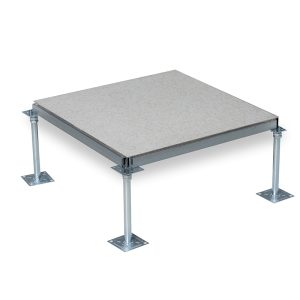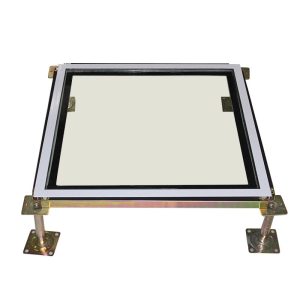
Aluminum Perforated Raised Access Floor Panel

Product Overview
The aluminum perforated panel is manufactured through secondary processing based on solid aluminum panels. Two main forming methods are available. One method uses fixed airflow-rate molds to punch solid aluminum panels, while the other employs CNC milling to produce perforated panels with customized hole patterns and airflow ratios.
The standard open area ranges from 17% to 43%, with additional airflow ratios available upon request. When used in combination with air dampers, the airflow rate can be freely adjusted. The perforated panels can be installed together with solid panels to meet both ventilation and load-bearing requirements in data centers and other technical spaces.
The standard panel size is 600 × 600 × 55 mm, and the surface is typically finished with permanent anti-static PVC covering or powder coating.
Application Areas
The aluminum perforated raised access floor panel is suitable for high-technology industries, including:
Microelectronics industry (wafer fabrication plants, TFT/LCD manufacturing, packaging and testing, PCB production)
Semiconductor industry
Flat panel display industry
Optoelectronics
Life science industry
Precision engineering
Ultra-clean electronic manufacturing environments
Product Features
Precision-engineered design with high dimensional accuracy
Lightweight construction with excellent load-bearing capacity
Optional conductive and static-dissipative surface coatings or coverings
Iron-free composition to prevent interference with sensitive magnetic field environments
Outstanding rolling load performance
Die-cast aluminum panels compliant with A1 fire resistance rating
Reliable waterproof performance
Non-polluting and radiation-free, environmentally friendly
Recyclable materials supporting an economical and sustainable system
Compatible with various pedestal and support structure systems
Product Advantages
Aluminum raised access floors are primarily used in cleanrooms, electronic workshops, and other electrostatic-sensitive environments. These areas typically contain a large number of integrated circuits (ICs), which have limited tolerance to high-voltage electrostatic discharge. Components such as field-effect transistors are particularly vulnerable to static electricity. Electrostatic voltages can range from tens to several thousand volts, easily causing damage to integrated circuits. Therefore, electronic cleanrooms must place strong emphasis on electrostatic protection, ideally minimizing static generation at the source. Aluminum alloy anti-static raised floors effectively accelerate static dissipation, ensuring the safe operation of high-precision equipment.
Compared with other raised flooring systems, aluminum raised access floors combine lightweight design with exceptional load capacity. Once installed, the system remains highly stable and does not shift or deform under heavy equipment loads. In addition, aluminum offers excellent corrosion resistance, and the dust-free surface requires no special treatment, making it ideal for long-term use in clean environments.