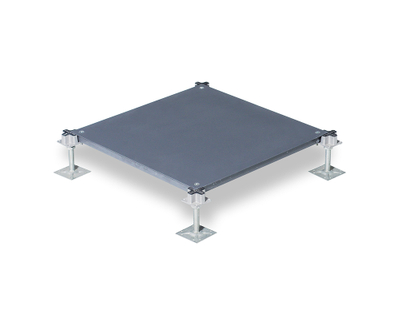
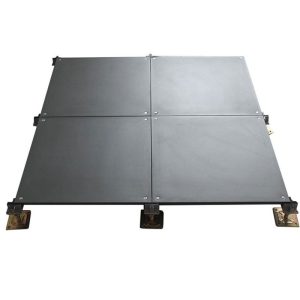
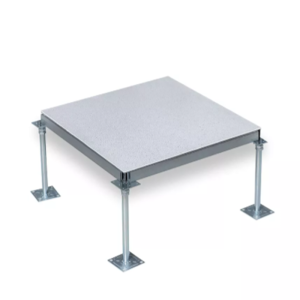
The anti-static raised floor system is built on a standard steel cement raised floor structure. Both the top and bottom layers are encapsulated with high-quality cold-rolled steel sheets, while the core is filled with high-performance foamed cement to ensure strength and dimensional stability. The surface can be finished with various anti-static materials, such as High Pressure Laminate (HPL), permanent anti-static PVC, or anti-static ceramic tiles. Conductive rubber edge strips are installed along all four sides of each panel to protect the edges and enhance electrostatic dissipation. The complete system includes raised floor panels, pedestals, stringers, and other installation accessories, forming a fully integrated raised floor solution.
Applications
This product is suitable for data centers, computer rooms, control rooms, laboratories, telecommunication facilities, power control centers, industrial workshops, and other professional environments that require strict electrostatic protection or extensive cable management.
Product Features
Outstanding anti-static performance
Multiple practical properties, including fire resistance, slip resistance, corrosion resistance, and moisture resistance
Strong and reliable bonding with no air bubbles or delamination
Complies with Class A fire performance standards for flame spread and smoke development
High load-bearing capacity, suitable for heavy-duty applications
Product Advantages
Electrostatic discharge (ESD) can cause intermittent equipment malfunctions and computational errors, and may even result in permanent damage to sensitive electronic components such as CMOS and MOS circuits. In addition, computer peripherals can also generate static electricity. Therefore, anti-static flooring is essential in environments such as data centers, server rooms, and computer facilities.
Data centers and technical rooms often require layout adjustments to accommodate changing users and business demands. Traditional infrastructure can quickly become outdated due to technological advances and frequent cable modifications. Designers and facility managers must balance construction schedules and cost control while responding to constantly evolving spatial requirements. In equipment-dense environments, it is crucial to eliminate the negative impact of static electricity on all devices, extend equipment service life, and manage increasingly complex cabling systems.
The all-steel anti-static raised floor system supports fast and convenient installation as well as flexible cable replacement, enhancing space configuration flexibility without interrupting power supply, communication, data services, or HVAC system operation. The anti-static surface layer effectively dissipates static charges and helps distribute conditioned air, optimizing environmental temperature control and airflow management.